An agency made of agents
4EVR HQ started with someone else's screen. A friend had a pixel-art office full of characters walking about, and a panel where he could hand them tasks and follow what each was doing and saying. In that set-up, he was God. I asked Claude what he was doing and whether it could build one, then handed it an open-source library of marketing playbooks and a single instruction: build the world's best marketing company, and call it 4EVR.
That was the morning of 11 October. A week later it was an open-source beta with sixteen agents, 154 passing tests and one dependency. This is what I was after, and how far it got.
What I was after
I work in marketing and communications, and most of the job isn't the writing. It's turning a vague ask into a brief, finding out what's true, getting the right people to look at it, and checking the work before it goes out. I wanted to know whether a team of agents could run that whole loop, not just the last step: take a one-line request like "get example.com more qualified leads: 40 enquiries a month" and come back with researched, reviewed work someone could use.
My first README put it plainly: what if a marketing agency were a team of AI specialists you could watch work? The watching mattered: I wanted to see who did what, who they asked and what they couldn't find, rather than trust one answer out of a box.
How it's put together
Sixteen agents sit in seven teams, each with a lead, and a CMO called Vera plans the work. Their expertise comes from two open-source libraries, one for marketing and one for HR: 196 playbooks in all, and each agent works from the full text of the ones it owns. A task goes through ten steps: research the client's site and the wider web, write a brief, split it into three to seven workstreams, do the work, and have each piece reviewed by its team lead and then by someone from another team (a real problem earns one revision). Vera checks the pieces against each other, writes the summary and runs a retrospective whose lessons feed later work.
Two ideas carry most of the weight. The first is that agents look before they ask: the client's site, then the internet, then any connected tools, and only then you. What's still missing goes to an Inbox, capped at three requests per agent and eight per task, and a request that doesn't say what was already searched is refused. Nothing waits on you; the agent carries on with a labelled assumption.
The second is that the important limits aren't the agents' to decide. The team can hire, but only specialists built from real playbooks, and never past the caps (24 people, 12 hires, 3 per task). A small People & Talent team writes job descriptions and performance reviews, but the rating is a rule (Exceeds at 90% first-pass approval, Meets at 70%, nothing until three pieces have been reviewed) and letting anyone go needs my approval. All of that lives in code, so the agents can propose but can't change the rules.
It runs three ways. Simulated needs no key and stamps every deliverable SIMULATED. With an API key, or through a signed-in Claude account, real models do the thinking, under a $5 budget cap that drops back to simulation when it's reached.
What broke
The first real test was a one-line instruction pointing at a real company's website, and it fell over. The agents couldn't open the site, treated a vague request as a complete brief, and routed "leads" to cold email. That's where the research step, the structured brief and the rule that anything not read on a real page gets labelled Not verified came from.
The second was more humbling. Everything had been tested against fake versions of the model API, and the first live task sat in planning and then failed every workstream. The tool loop was sending the model's signed thinking blocks back to it, which the real API rejects, and planning had been quietly falling back instead of saying so. The fix was small. The lesson was a stricter fake that enforces the real request rules, deadlines on planning, and the reason for any failure shown on the task card.
A full audit a week later found that a double-click on Retry could run a task twice, and that simulated estimates counted against the budget cap, so demos could block real runs. I also capped cost: Sonnet for Vera, the leads and long client work, Haiku for short structured work and quick replies, and nothing more expensive, even if the key allows it.
The office
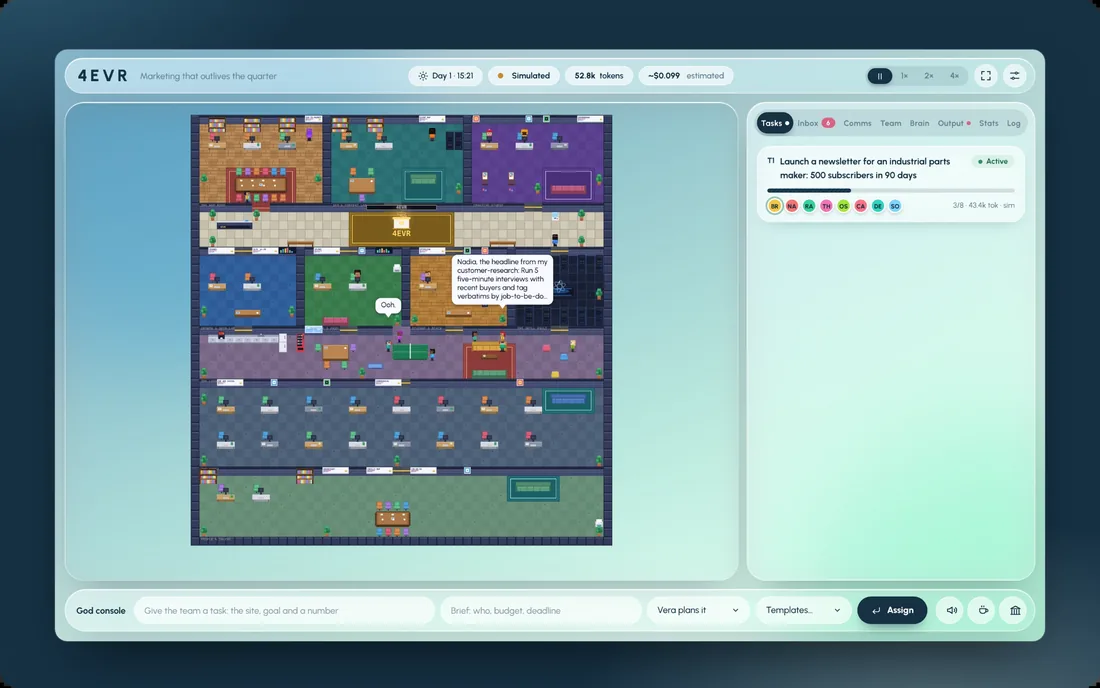
The pixel office is how you watch it. Agents walk to each other's desks to consult, type while they work, meet at a council table, and wander off for coffee when their energy runs low. There's a dog. It's the part people notice first and the part that matters least to the work, but it turns a plan you can't see into a room you can.
Where it got to
It's at version 0.9.0-beta.1, MIT-licensed on GitHub, and runs on your own machine, starting in simulated mode. It works end to end, and everything it produces is a draft for a person to review.
What it doesn't do matters as much. The agents can't log in to ad platforms, analytics or a CRM, or change a live site, and that's on purpose. It can't read Claude Projects, which I'd asked for. There's no sign-in, so it belongs on your own computer. And the live paths are tested against fakes, not real services, so the 154 tests prove the plumbing rather than the quality of the marketing.
What worked was the asking and the rules in code: the Inbox shows gaps instead of papering over them, and hard limits made it easier to let the agents get on with things. What surprised me was where the time went. The agents, teams, hiring and learning were all in by mid-afternoon on the first day. Much of the rest went on stopping, retrying, budgets and honest error messages, the dull machinery that decides whether you'd trust it with anything.
Next, I'd run real briefs through a live model and see whether the lessons actually lift first-pass approval, which the system measures but on a small sample so far. Then an approval flow, before any agent gets near an account it could change.
- Built
- 11 to 18 October 2026, by directing Claude Code
- Stack
- Node, one dependency (
ws); Canvas 2D in the browser; 154 tests - Where it got to
- Open-source beta (v0.9.0-beta.1): sixteen agents in seven teams that research, plan, review, hire and learn, runnable locally in simulated, API key or Claude account mode. Not yet proven on real client work.
- Mockups
- Built with Stageshow by Benji Taylor
- Source
- tomxander/everythingiamworkingon